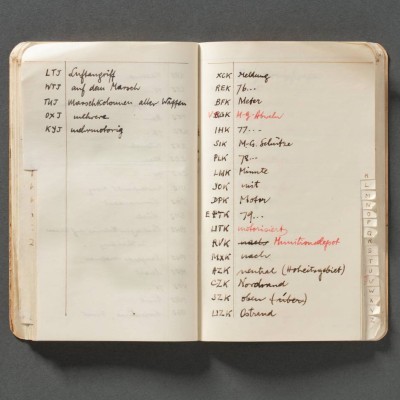
A code book is a reference document that allows the user to encode or decode a message. Some code books achieve this by providing a list of steps the reader can use to manually encode a message, while others function like a dictionary and provide a reference list so that the user can look up a word and its encoded counterpart.
To decode a message, both the sender and the receiver must be in possession of identical code books. Codes are compromised if an external party obtains the code book. Consequently, these books were closely guarded secrets, and it was common practice to periodically adopt new code books and destroy old ones. To break an adversaries code, an analyst could identify particular words in the code and use them to gradually populate their own interpretation of the code book. Allied code breakers also used captured code books when available.
The Allies used various types of code books during the Second World War. Allied code breakers used captured code books, such as the Luftwaffe (German air force) trigraphic workbooks, to decrypt German communications. They used others, such as the Cypher ‘B’ and four-digit numeric code books, to encrypt Australian military communications