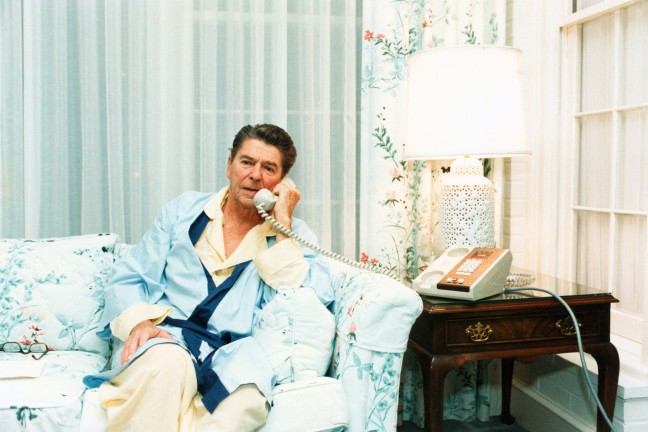
The need for secure communications has driven advances in technology. The STU-II consisted of the bulky KY-71 cabinet that housed the main electronics, and the HYX-71 telephone unit that served as the control system. The United States National Security Agency (NSA) Key Distribution Centre distributed the keys either as a paper-tape or as an electronic key transfer device.
Calls would initially connect in CLEAR mode, and the user would press the SECURE button to switch to a secure connection. It took 10–15 seconds to activate secure mode, during which time the machines exchanged encryption keys.
Users could configure the settings for mode, initiation, key-loading, and simultaneous or non-simultaneous communications via the KY-71 control panel. The speaker had to press the push-to-talk (PTT) button to be heard. In case of emergency, or if the keys were no longer needed, the key distribution device could be purged by turning the ‘ZEROIZE’ knob.
President Ronald Reagan used the STU-II to make an early morning secure telephone call regarding the invasion of Grenada by the United States in 1983.
In the 1990s, the Defence Signals Directorate and Telecom Australia (now Telstra) developed a more streamlined, simple, and secure telephone unit named the Speakeasy.