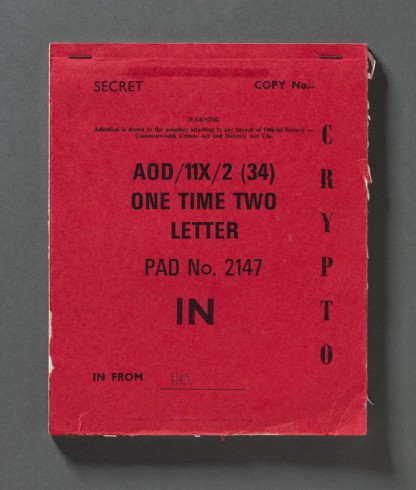
Highly secure, one-time pads use a single-use pre-shared random key. One-time pads were more secure than Typex-like encryption machines, but less practical because they were difficult to use and support with key generation and distribution. One-time pads were often very small for easier concealment and hidden inside common objects such as travel kits, pens, photograph frames and even walnuts.
One-time pads could be used in various ways. For example, the sender could convert the message into a string of numbers. For uniformity, the numbers were separated into five-numeral blocks using a basic system, such as a = 01, b = 02 … z = 26. The string for ‘HELLO’, for example, would be ‘08051 21215’.
Then, to encipher this string, a random series of numbers equal to or longer than the original message was merged with it. Lining up the strings of numbers in vertical columns meant the digits could simply be added together, but where the result was greater than 9 — for example, 5 + 8 = 13 — only the units digit (in this example, 3) was used. For example, ‘HELLO’ ended up as ‘58237 88688’.