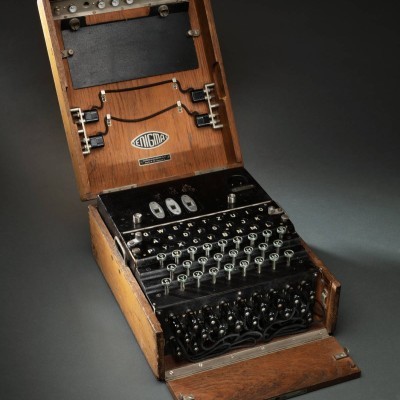
German military forces used the Enigma cipher machine in the Second World War to secure their communications. An exceptionally difficult machine to break, it used a series of internal rotors and a plugboard that transformed the message into an indistinguishable string of letters. German military forces then sent out the text by radio using Morse code. Only by knowing the initial rotor positions and plugboard settings, which changed daily, could the recipient decipher the message.
Work on breaking the Enigma began even before war broke out. Polish cryptanalysts were able to read limited amounts of Enigma traffic during the 1930s. At Bletchley Park, Buckinghamshire, home of the Government Code and Cypher School (GC&CS), British mathematicians Alan Turing and Gordon Welchman invented an electro-mechanical device called the ‘bombe’ that was specifically designed to identify the initial position of the Enigma rotors when a message was sent. The Poles had designed an earlier version — ‘bomba’ in Polish — in 1938.
By progressively breaking the Enigma ciphers, the Allies could read German communications giving them a strategic advantage. The Allies codenamed the intelligence from decrypted Enigma traffic as ‘ULTRA’.