
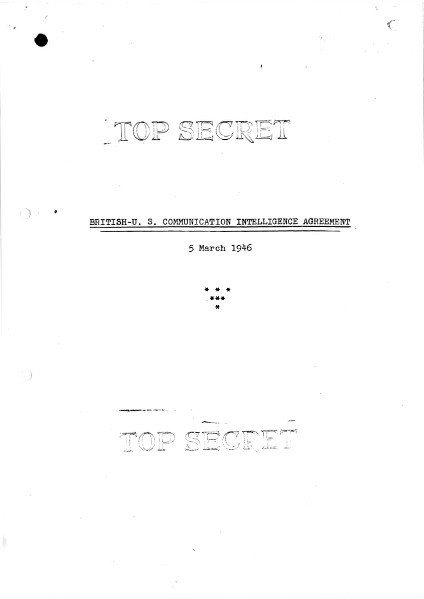
During the Second World War, the Allies drew strength from their partnerships. In 1946, the British-US Communication Intelligence Agreement (BRUSA), later the United Kingdom – United States of America Agreement (UKUSA), formalised the post-war signals intelligence relationship between the UK and the USA. Initially between the UK and the USA, the UK ultimately sponsored the entry of Australia, New Zealand and Canada into the partnership.
It was not until 1956 that the Australian Government formally accepted the agreement and the Defence Signals Branch formally joined the alliance. The UKUSA Agreement formalised the basis of what eventually became the multinational signals intelligence, or Sigint, alliance known as the ‘Five Eyes’. The existence of the Agreement was withheld from the public until 2005, and in 2010 many of the details in the Agreement were declassified and released to the US and UK national archives.
Today, Australia’s ‘Five Eyes’ intelligence partners are Canada’s Communications Security Establishment (CSE), the United Kingdom’s Government Communications Headquarters (GCHQ), New Zealand’s Government Communications Security Bureau (GCSB), and the United States’ National Security Agency (NSA). ASD also works with other signals intelligence partners outside of this agreement.
ASD and Australia have benefited immeasurably from the Five Eyes arrangements. Australia has made effective contributions to the partnership, which has delivered significant benefits to the nation through technology, innovation, expertise, capability and ‘reach’ — all of which would have been difficult to achieve independently.